Friday, June 18, 2010

Showtime

My personal favourite surprise from E3: Donkey Kong Country Returns.

So E3 is over for yet another year and, as countless other people are doing, it’s time to offer the obligatory impressions on the show this year. I don’t want to dwell on my personal interests too much -- as frankly, who else cares other than me? -- but I figured I’d still jot these thoughts down in order to dump them somewhere and also have a record for future use.

Before I comment on the three conferences proper, there’s something I need to get off my chest.

What the hell was that “speech” in Sony’s conference by Kevin Butler? I’ll admit straight away that I do not and probably never will understand the appeal that he has garnered in recent months, but irrespective of that, the outburst of hyperbole he so confidently demonstrated on Tuesday was, in a word… baffling. I get the idea that it was done to inspire a certain demographic -- namely the hardcore -- and as a direct result, give Sony the attention and perhaps even ‘victory’ at E3 they so desperately want to achieve, but its presence in a conference clearly focused on new technology and dedicated to other, perhaps new demographics is not only ironic, it’s just simply discordant. The problem is that, as intended, the crowd responded positively, perhaps even egregiously, and so too did the fanboys. But shouldn’t that be a good thing? By achieving a reaction in both the hardcore and, hopefully, the “casual” -- or in other words, everyone else -- surely that makes their conference a success, as a demonstration they have products for everyone and as a clear, perhaps blatant, indication to their competition that Sony are coming? Well no, I don’t think it does. Like Microsoft -- and I’ll discuss this further in a minute -- Sony segregated the markets by allowing this tirade to feature prominently, and promptly did it again when they showed the video with the PSP kid. Where their boasting about their new technology and where they expect it to be in the next few years was intriguing but otherwise nothing extraordinary, their appeal to the hardcore was outrageous and elitist: an extreme example of Sony fueling the fire just for the sake of it. And really, what did they have to lose? Microsoft already separated the industry into two categories with their showing while Nintendo surprised with nostalgia; it’s not about the games anymore, it’s about the image, and, especially with 3D in tow, that’s all you’re going to hear about from Sony in the years to come.

Right, in an ironic twist (or not), my little rant is done; onto my own personal opinion of the three conferences.

Microsoft

It feels somewhat strange saying it, but not a single game (or should that be product?) that Microsoft presented on Monday was interesting. What was shown was intended for markets that, for now at least, aren't for me: starting with the shooters and ending with a variety of Kinect related software that I’m either uninterested in, have seen before or just can’t understand until I get to experience it for myself. I don’t care about Call Of Duty, Halo or even Gears (a series I have enjoyed in the past) nor can I care for Fable III or Metal Gear Solid: Rising when I’m still yet to thoroughly play their predecessors. I am burnt out by the industry’s emphasis on all things shooting, weapons and violence and all the supposed core titles shown at the start of MS’s show just weren’t for me.

As for Kinect, I’m intrigued by it but, like every other new piece of technology this medium has seen in the past, it will live or die by its software and right now, the software I saw is limited in its potential to capture appeal. Yes it will inevitably appeal to consumers already familiar with Nintendo’s recent offerings; yes, it could indeed captivate new audiences, increasing the popularity of our medium even further; and yes, it might even eventually have some really fantastic, unique, ways to enjoy interactive entertainment. But in the meantime, their persistence to chase the unknown, to go after markets that might not necessarily be there, winds up leaving the audiences they already do have behind, and I’m not sure that will be beneficial to them in the end. But then again, does it matter? According to them, we’re already two different industries anyway.

What I don’t understand, though, is why such a small crop of games? Yes this year’s demonstration was always going to be about their new technology, and yes, it was always going to feature the big three blockbuster franchises too, but even so, why did Microsoft choose to hold some of their games -- some of which we already know about I might add -- back, such as Crackdown 2? Just further proof that it’s not about the quality of games anymore but rather the experience these consoles can provide for you, me, and your entire family. I guess it’s up to you whether that’s a good thing or not.

Gorgeous. Definitely looking forward to this level.

Nintendo

Nostalgia sure does have a way to get everyone talking, doesn’t it? Whether it was the sighting of Nintendo’s three crucial characters -- Mario, Link and Samus -- or new additions to franchises we may have left in our memories, the variety of games they showed this year was an incredible grab for the hearts of those who have grown up with Nintendo or at the very least have a history with them, no matter how large or small. But it wasn’t just an appeal to the loyalists, the supposed hardcore, which made their conference interesting: it was a genuinely enjoyable demonstration to watch because, unlike the other two, there were no smoke and mirrors; it was just genuine product after genuine product.

Taking the time to show off the new Zelda first was a clever move. We knew it was coming, we weren’t sure what to expect, and within minutes we knew that, yet again, there was reason to be excited for a new adventure. I’ve already mentioned briefly in the past that my interest in the franchise isn’t as strong as others, but even I’m intrigued by what was shown and keen to learn more, so kudos for grabbing the attention of someone who usually just observes from the corner. Aside from that, focusing the conference on the games instead of the hardware was also clever, the 3DS sounding genuinely impressive but largely irrelevant to me until I can try it for myself.

Ultimately I believe what Nintendo showed with this conference is something more important than an impressive line up of games or indeed future hardware: they proved that they get it when it comes to videogames, something that only a select few other developers (think Valve, Rockstar, Blizzard) can manage consistently in this industry and for me, that is why their conference was the most enjoyable. It’s not about the profits, image or corporate ego -- though, in yet another clever move, they manage to succeed in those areas too -- it’s about the medium, past, present and future.

Oh and Donkey Kong, a game I’ve been wanting to happen -- regardless of which console it appeared on -- ever since I finished the original SNES trilogy the first time, let alone the fifty times (each) after that.

Sony

I’ve already explained my disdain for the way Sony approached their conference this year, the blatant segregation of markets as if they were totally different industries really unnerving me in a way I didn’t expect, but to their credit they did show games, it’s just a shame that yet again hardly any were for me.

I’m sure Killzone 3, in 3D, will be great. Maybe not Avatar* levels like Sony suggest, but I highly doubt the game will be terrible, especially as the forebear for Sony’s push for 3D gaming. It, alongside other games both old (Wipeout HD, PAIN) and new (Gran Turismo 5, MotorStorm: Apocalypse), will probably prove that Sony’s massive commitment to 3D was justified, if not necessary, in much the same way that Move will demonstrate that motion controls do have their place in the videogame medium -- just not as much as Sony would have you believe. Their lineup was filled with variety, something that everyone will likely appreciate, but even so it wasn’t all that original, and the impact of their presence throughout the conference was hindered by leaks and announcements in the week prior. InFamous 2, MotorStorm: Apocalypse and Killzone 3 were already known about, as was, for the fourth consecutive E3 in a row, Gran Turismo 5. Speaking of which, nothing new was shown about that game except for the release date, something the game has already had in the past and can’t be trusted until it actually does come out. The Top Gear track, highlighted as if it’s more important than other tracks, was already known about and while seeing The Stig was admittedly new, it was also expected (as, unlike the show’s three presenters, licensing or legal issues wouldn’t be as complicated), just like previous GT5 reveals in earlier months were, such as the inclusion of the Nurburgring or night racing. It was nice to see LittleBigPlanet 2 (though unfortunately for me I missed some of that as I had to get a drink for my little sister) demonstrated, and no doubt, for those interested, the Twisted Metal reveal at the end is welcome, if unsurprising news.

All in all, Sony had the games which earns them some respect, but the focus on their new technology and the separation of their potential audience, combined with blatantly obvious, derivative and completely unnecessary digs at the competition (Kevin Butler’s rant included) brought it down for me. A personal shame because it really feels like for every step forward Sony make, they take another two back, leading to confused and mixed feelings about how I feel about them, the PS3 and their piece of the gaming pie in general.

So that’s E3’s conferences from my perspective. For someone usually regarded as a Microsoft fanboy (I will never understand that), I think I did a pretty good job of keeping things fair with my comments. I realise that what both Microsoft and Sony are doing aren’t for me right now, and that part of Nintendo’s appeal this year was inspired by nostalgia, but even so if there are any examples of unfair bias I really don’t mean to communicate it. My love is for the medium overall and, after a mixed affair of excitement and confusion, I am struggling to work out where it appears to be headed. But that’s okay, I’ll continue to observe with interest and in the meantime, there are plenty of games already available that I need to spend some time with, so that’s where my thoughts will lie for the foreseeable future. Past, present and future -- it’s all good.

*I’m still yet to see this movie.

Thursday, June 3, 2010

A Trio Of Impressions

Three brand new videogames have held a firm grip on my attention lately, two of which are all the rage right now -- Alan Wake and Red Dead Redemption -- and another which is seemingly praised by the community but has otherwise been overlooked (perhaps because of the supposedly bigger titles) ModNation Racers. All three were anticipated by me for various reasons and now that they are here, it has been interesting to not only see if my excitement was justified, but also how I have responded to their remarkably different but thoroughly compelling approaches to entertainment.

All three have inspired some thoughts I will elaborate on in future posts but in the meantime, here is what I have gathered from my initial hours of play.

ModNation Racers

It saddens me, in a way, to admit that I have barely played this, but simultaneously sounds absurd as I've already played it for well over five hours. The first of the three to arrive, ModNation is perhaps the quietest of the bunch: a nice combination of racing, creativity and personality that is easy to enjoy in short bursts or in longer sessions, but doesn't seem as significant as the other two. Observing the general response people are having to these games reveals that, but I suppose I'm guilty of it too as I haven't touched it since that first session.

But what a session it was! Not only did firing it up allow me to discover a riveting kart-racer, it also pleasantly surprised me with just how easy it was to explore and, more importantly, enjoy every facet of its offerings. Sure it was heavily marketed as an accessible game, its track design tools yielding results far quicker than level creation in LittleBigPlanet, but even so I underestimated the game and perhaps as a direct result I'm enjoying it a lot more. It has already been neat stumbling across recreations of real-world race circuits as well as ones yanked straight out of other games, plus it brought a smile to my face to see Mario and Luigi standing on the podium of the game's ModSpot, where all of the game's modes are accessed and, when online at least, interactions with other players can take place. All in all my first time with the game showed me that it is right up my alley -- as I suspected back when it was announced -- and I definitely look forward to spending more time with it in the future. If only I could pry myself away from...

Red Dead Redemption

One of the reasons I listed as key in my anticipation for this game was the way it could potentially use its space to convey an immersive, believable world, and after spending a decent amount of time with it, I'm happy to report that it has achieved that and has done so with ease. But I suppose I shouldn't be all that surprised; Rockstar are renowned for their attention to detail and intricate design when it comes to capturing a theme, period, era or all of the above. Whether it's in the school yard or a bustling city, they always manage to achieve a certain atmosphere and ambiance, and it's certainly no different in Red Dead Redemption. I realise that might sound a little hyperbolic but I definitely think that is one of the company's best attributes, regardless of whether the games that exist within those spaces are any good or not. Speaking of which, being such a large game, I hesitate to try and grasp my opinion on it until I've played more, so more thoughts in the future.

One thing I will admit though is that the game has been incredibly overwhelming. Not only have I had to learn new mechanics, dynamics, characters and locations as you would in any new videogame, I've had to do it all whilst also learning about what a Western is all about. As I also mentioned in my anticipation post, I am completely new to any thing and all things Wild West, having never experienced the genre before playing Red Dead Redemption. Living under a rock as I do, everything Rockstar's latest game has presented to me so far has been completely new, and that's why it has been a touch overwhelming. I've handled it -- it's not the kind of thing that you can't handle -- but it has still been interesting as I've reflected on everything I have experienced so far. The good news is that my curiosity for the Western has been piqued and I'd like to play more, so that's precisely what I will do. For months, I suspect; because games like these are more like secondary lifestyles than simple experiences -- but I'll elaborate on that in another post.

Alan Wake

Despite my intrigue with Red Dead Redemption and indeed the incessant conversation, praise and post-hype that surrounds it at the moment, Alan Wake has been the most enjoyable game of the trio so far. I'm reluctant to think about why that is, however, as I'm uncertain if my desires to play it -- lasting as long as the game was in development -- are influencing my opinion or not, but that's something to contemplate once the game is finished.

What I can say is that I really appreciate the more realistic characters I've come across so far; the sheer beauty that Bright Falls exudes (at least, during the day) and the genuine scares it has induced in me thus far. If you will recall, I wanted it to scare me or keep me on the edge of my seat, to tell me a compelling story, and I wanted Bright Falls to be a place that I enjoyed visiting -- omnipresent darkness be damned. So far, at the conclusion of the game's third episode at least, Alan Wake has achieved all of this, but we'll see how things go as I continue on.

Despite my messy, rambling impressions of each game so far, there's one conclusion I can offer after spending time with these games: I have a good understanding of what I want in the videogames that I play, and these three have delivered that superbly so far. I'll explain what I mean by that after I've played the trio some more.

Wednesday, June 2, 2010

Space Invaders: Bully's Brevity

[Part of an ongoing series of posts exploring the way videogames use their spaces to convey their overall experience, ranging from design and dynamics to aesthetic and artistic appeal, and everything in between. Be warned, there are potential spoilers ahead.]

The town of Bullworth in Rockstar’s Bully really surprised me, its design and appearance being a lot different to what I was expecting and its smaller scale enhancing the game’s approach to schooling in a remarkable way. Instead of a bigger is better approach, the developers went in the opposite direction and the end result is a demonstration, yet again, that Rockstar know what they’re doing when it comes to creating and forming a unique world that accommodates the theme they’re trying to convey, and the gameplay ideas they want to explore within.

The first thing I want to point out is the idea that Bullworth is a town, not a city ala the ones featured in the Grand Theft Auto games, and while this might feel like a step back after the evolution that franchise has seen, it is in fact a step down another path, a smaller and more concise one that suits the theme of the game and makes sense within the context such a theme provides.

Bullworth feels like one of those towns where everybody knows each other and this feeling is exacerbated by the ubiquitous presence of the game’s many students. These teenagers don’t just populate the school’s many different areas as idol pedestrians to give the illusion of life in Bullworth; they actually live in the town and as such roam the various parts of it when they’re not required to attend their classes. Continuing the stereotypical parodying of school cliques, certain types of students -- nerds, preppies, etc. -- will appear at certain places in town, making it not only a more fleshed out place generally but also making it easy to find certain students if and when the need arises. The comic book store is where the nerds can be found while the preppies enjoy hanging out at the boxing gym; greasers can be found roaming the streets of New Coventry while the bullies can be found down on the beach, sometimes smoking, sometimes playing Frisbee. It gives Bullworth a sense of place as well as a sense of belonging for the game’s many characters, and it culminates in a community-like feeling that makes playing Bully strangely relaxing. Bumping into recognizable characters on the street such as Algie or Lola can yield a smile as you realise that, first and foremost, they’re not just quest-givers or conduits for information, and secondly, that you actually are getting to know these people: where they hang out, who they hang out with, what they represent (cliques) and what events they have been involved with. Unfortunately the technical limits of the game -- with it appearing on the Xbox 360 and Wii it’s easy to forget that Bully is a last generation game -- means that this illusion of community is ruined from time to time as you see the same characters appear repeatedly within the span of just a couple of minutes. It’s a small issue that you soon forgive and ignore, but one still worth mentioning all the same.

Bullworth Academy -- the place where most in-game time is spent -- is interesting in its own right. Existing almost in the centre of town, the place isn’t just important to the theme and story of the game, it also acts as a hub to the remaining areas, with roads and pathways leading to different sections of Bullworth. It doesn’t sound like anything special when described like that but it does make sense: the school is already the key focus of the game so by being the prominent building and area, its significance and familiarity is continually reinforced, reminding the player that at the end of the day -- quite literally -- that’s where they need to be.

The design of the school is also interesting, the aforementioned cliques each having their own section while the central and main building contains the majority of classes. The boys and girls dormitories sit at the front of the school while the football fields and observatory exist at the back. The greasers have their workshops; the nerds love the library; the jocks train on the fields and the preppies always converge outside Harrington House. Having these areas circle the main building makes sense both in terms of the stereotyping the game revels in as well as the cliques’ need to access their various classes. It also means there is always something to see while hanging out around the school, with rival students engaging in fisticuffs, couples walking together hand-in-hand and the school’s prefects constantly giving chase to troublemakers. As far as the player is concerned, the central focus Bullworth Academy maintains means that it’s always easy to access the classes that need to be attended or to find a particular clique at will, wasting less time when participating in the narrative or when performing a side quest such as taking student photos for the yearbook.

The Academy isn’t the only landmark that becomes familiar throughout play, however; Bullworth is punctuated by multiple landmarks that enhance the ease of becoming familiar with the town and provides neat little hot-spots to visit sporadically. Ranging from a dam to a lighthouse on the beach to the town hall and carnival, each landmark is recognizable, can be seen from a distance -- giving a sense of direction -- and is carefully spread out so that players never get lost. This is different from, say, Liberty City in Grand Theft Auto IV where landmarks are few and far between, spread out over a longer distance and can only be seen periodically. It once again leaves the impression of a more concise and compact game space, and while easy to overlook during play, really benefits the overall experience that Bully provides.

Last but not least, Bullworth also conveys the passing of time quite nicely by taking full advantage of a year’s given seasons. While related more to the game’s narrative than the town itself -- in particular the progress Jimmy Hopkins, the game's protagonist, makes as a student throughout each semester -- it’s still interesting to see the aesthetics of Bullworth change depending on the season. Most obvious is Winter, which takes place throughout Chapter Three. Snow covers the city; snowmen pop up everywhere; Christmas decorations adorn the school grounds; and a giant Christmas tree stands outside the town hall. While essentially just subtle tweaks, these additions as well as those that feature in the other seasons and the dynamic weather -- something I wasn’t aware of until late in the game as it took so long to occur -- add to the game and accentuate the feeling that Bullworth exists with or without you.

Ultimately the town of Bullworth is a neat little location that doesn’t rely on bells and whistles to awe its players and instead utilizes a quaint, dainty feel that makes the player feel at home as well as part of a community. It may not be that big, it may even get repetitive after a while, but it’s familiar, it suits the mischievous theme and presentation, and it’s unique in a genre that is arguably becoming over-saturated. It might not be a significant part of gaming history like Liberty City or Rapture may be, but it is a significant part of Jimmy Hopkins’ life, and really, isn’t that all that matters for a young delinquent such as himself?

Friday, May 28, 2010

Friday Night Forza: Tunnel Vision

In my last post I referenced an approach to driving around a race circuit that I labeled as “Tunnel Vision”, suggesting that it appears when a driver’s concentration is at its highest, usually in relation to an attempt to be as precise around the race track as possible -- so in other words, all the time.

So what is Tunnel Vision?

Tunnel Vision is the term I use to describe when concentration and focus is so high that only what is in front of a driver at the time matters, and only the crucial details -- an opponent’s car; the approach to an upcoming corner; whether there’s any debris on the track; stuff like that -- matter. It’s when the objects in the background and sidelines become a blur, and when the edges of the track or its walls are the only important things that surround a driver and his or her car. Like a tunnel on civilian roads, the view and momentum is funneled forward: there’s no turning right or left as that’s when mistakes or collisions can be made, and going backwards is against the rules of the road or, indeed, the race track. When concentration is at its peak and focus is strong, the track or even minutiae parts of it, such as the racing line, becomes like a tunnel: attention is on what is ahead and what’s on the sides or behind doesn’t matter.

Interestingly, this Tunnel Vision phenomenon doesn’t just apply to the edges of a circuit or, in the case of a street circuit, the walls that line the course. Upon hearing my description for Tunnel Vision, it would be easy to associate and assume that it is the edges of a track I’m talking about. This is true to some degree, but as I’ve already alluded to above, things within those edges can form and be a part of one’s Tunnel Vision. The first obvious one is the racing line: the general and quickest line through each of the track’s corners and the most commonly used, by all drivers, route throughout a course on any given lap. Venture off this line and a multitude of things can arise or affect your race, maybe even both. The level of grip might not be as strong, meaning you become slower as your tyres work harder; leftover rubber from tyres -- commonly known as “marbles” -- can adorn the edges of a racing line and make the handling of your vehicle more slippery; or your approach to a corner may be more difficult because you’re not lined up to take it as fast as possible and thus, your general lap speed slows down as you do to accommodate. It’s logical then to try and stay on this line as much as possible in order to maintain consistency in pace per lap, as well as to ensure that, in a race, opponents have a harder time overtaking you. I’ll talk about overtaking, especially as it relates to racing games, in a future post.

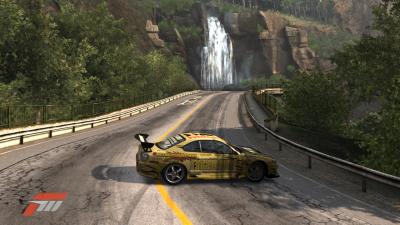
Tunnel Vision: You're doing it wrong.

But sometimes, Tunnel Vision can go beyond the edges of a race track or its racing line. It can narrow or widen at will, based on what’s ahead at the time and how a driver responds to it. For example: when trying to line up a pass on an opponent, the edges of a driver’s Tunnel Vision can alter based on what that rival is doing. If they choose to stick to the racing line heading into a corner, then suddenly the Tunnel Vision can widen beyond the racing line as a passing opportunity up the inside arises. Instead of being single file on the racing line, the track becomes wider as the cars go side-by-side, maybe to the edges of the track, maybe to some point in-between that’s suitable enough to make the move and nothing more. Of course, that doesn’t always mean the pass is going to be successful but alas, I digress.

How does this relate to racing games and in particular, Forza 3? Well just as these games simulate the various mentalities that can arise effectively, they also simulate Tunnel Vision. As I suggested in my previous post, if my attention is not fully dedicated to the racing line, the clock, or both, then I’m not at the peak of my potential ability as a driver and I’m allowing distractions, such as the paraphernalia that adorns the background and sidelines of the circuit, to set in and affect my chances in achieving my goal. It is a small aspect of racing but one that is absolutely crucial to my -- and presumably everyone else’s -- success. Get it wrong and the desired result -- winning, pole position, etc. -- is a lot more complicated to achieve, but get it right and the result is, well, perfection.

Thursday, May 27, 2010

Just A Heads Up

I didn't want to make this small post as I'd much prefer it if things were going to plan, but realistically and unfortunately, they are not.

The computer I use to work on this blog has some problems and while right now things are okay, I can't trust it to be reliable at the moment. It has a booting problem and this week it has been freezing which has been forcing the need for reboots and thus, it not booting. Somehow we've managed to bypass this problem and get it working again but I can't guarantee how long that will last, so that's why I'm telling you guys, my readers, about it.

Basically, if this blog and indeed my online presence in general goes quiet suddenly, it's because of these computer problems. It's my only point of access to the Internet and therefore Raptured Reality, so if I lose that then the blog goes quiet whether I want it to or not.

I think you'll agree that overall -- despite some quieter months earlier in the year -- I've managed to pick up my consistency here, getting posts out as I've wanted and even needed to as I continue to offer my opinions and thoughts about our commonly shared interest: videogames. I've improved so much that I have actually managed to form a schedule, of sorts, for what I write, so I'm sure you can understand my hesitation with this potential unintended downtime and indeed disappointment should it occur.

Hopefully I'm just worrying over nothing and all can resume as normal going forward, especially with E3 around the corner. If things do go on as they should, then all this post is doing is embarrassing me, but even so I'd rather keep you in the loop than to have silence overtake the blog and as a result, for you to perhaps stop reading. My intention is to continue with my schedule as I would do normally so expect posts to keep on coming, but if they don't, you now know why.

And on a short side note, now is as good a time as any to reiterate: thanks to each and every one of you for taking the time to read my blog. I appreciate it immensely and without you people, my motivation to convey my thoughts and feelings would be a lot less than it is now. So again, thanks, it means a lot to me.

Friday, May 21, 2010

Friday Night Forza: Driver Mentalities

In terms of simulation the physics of the driving models in racing games like Forza Motorsport or Race Pro are usually what receives the attention critically, and for good reason too; If the physics and dynamics of racing a car quickly around a race track do not feel right -- regardless of whether it’s a controller or steering wheel being used -- then the illusion is broken and the experience becomes less enjoyable. Or worse, dull. Get it right, however, and it can be an exhilarating, fulfilling experience that is probably as close to real life racing as one can get in a virtual sense. But just because handling is the main focus that doesn’t mean that there aren’t other aspects of racing that are being simulated simultaneously.

Driving a race car consistently, precisely and most importantly, quickly, is an incredibly complex and involving task. Not only do drivers in real life need to manage the physical side -- acceleration, braking, gear changing and, of course, steering* -- they also have to manage racing mentally, and it’s here where racing sims do a pretty remarkable job of capturing the mental processes a driver has to go through not just throughout a race but in preparation for one as well.

Most real life race weekends follow a schedule that allows for drivers to learn the track; test various car setups that suit not only the track but its conditions as well (sunny, overcast, rainy, etc.); secure their position on the starting grid; and then, eventually, the race. The thought process in the approach to each session -- practice, qualifying or the race -- differs based on the performance of the car, the goals the driver or team may have, and the experience with how the track may or may not change over the course of the weekend. In practice for example, the mindset is relatively relaxed and it’s here where experimentation with setup, different racing lines and when to be on the track versus being in the pits can be used to potentially improve the prospects for the overall weekend. In qualifying, the mindset shifts to one lap dashes (usually involving three laps: the out/warm up lap, the actual lap where a decent time is hopefully set, and the in lap on the way back to the pits) where concentration, focus and absolute precision is necessary to set and achieve the best lap time. Arguably, it’s here where the track really does become like a tunnel, the driver’s vision not focused on anything else except what’s in front at the time. I’ll explain this “tunnel vision” phenomenon in a little more detail in my next post. Lastly we have the actual race, where the mindset once again shifts and all eyes point towards a victory. Concentration isn’t necessarily focused on precision -- though it helps -- with the location of competitor vehicles being important, and avoiding any collisions is crucial.

Something that both surprised and impressed me while playing Forza Motorsport 3 is just how amazingly realistic it is in recreating the various mindsets a driver has. Of course, to speed up the process and not alienate the more impatient audience of gamers out there, the way race events are presented in these games is significantly different to the way a normal race weekend pans out, but this is mostly irrelevant. Instead of practice sessions or qualifying, racing games have testing (for the tuners out there) and time trial modes, not to mention quick races or free runs. It’s in these modes that the varying mental approaches appear, and in reality it doesn’t matter what a mode or session is called because the end result is going to be the same thing.

I’m a fairly passionate person about time trial modes, as I enjoy the challenge in being as precise and perfect as I possibly can. As far as Forza 3 is concerned, I have a goal in mind to be in the top 200 people around the world for each specific time trial event, and, if possible, the various hot lap leaderboards as well. It’s a big ask but based on my experience with Forza 2, it’s entirely possible and I’ve already got a few decent times down. When I’m on the track pushing to be as perfect as I can be, my mind is focused entirely on precision, and getting the best out of the track and car I’m in. My focus is literally that of the tunnel vision I’ve already alluded to, and the side and background detail of a track -- including the walls if it’s a street circuit -- is ignored without even realising it. It’s just me, the racing line, and the clock, and if anything else enters into my concentration span then I’m not at the peak of my potential ability. This is a big contrast to how I approach a race, where, as in all racing games, all I care about is winning -- both for the progression throughout a game and because that is the ultimate position. Failure to win means restarting or retrying a race until that victory is secured, and anything else is just trivial distraction until that is achieved. This changes again when it comes to approaching, say, an online race against real people (as opposed to AI); the desire to win remains as strong as ever but the variables are different, so the approach needs to be. Racing against the AI cars is serviceable but mostly predictable: assuming how they will react as I make a pass or block my line into a corner results in relatively easy outcomes with very few surprises. Racing real people, on the other hand, is unpredictable: the lines that they take, how deep (or early) they will brake into a corner or whether they will try to ram you as you make a pass are just some of the unknown factors against real people. This unpredictability can make online racing really exciting, but also has more potential for collisions, unfair competitors and less of a chance to actually win. The differences in the various approaches I take depending on what I do in the game is remarkable, and extremely similar to how a real race driver would adapt to the conditions they may have to face.

Exit Strategy

At any given time on the track, a driver’s thought process can be focused on a multitude of things depending on the circumstances they find themselves in. Ranging from how they took the previous corner to whether they are close enough to an opponent’s car to make a pass, decisions are constantly being made based on what is being presented at the time. It’s no different in a racing simulation game.

I may not realise it while playing, but I too am making decision after decision as I make my way around a track, and as you’d expect, the choices I make will either help or hinder the outcome of my race. For example, exiting the final corner of America’s famous race track Laguna Seca can present many different situations to deal with. As I exit, I could be thinking about my throttle application because I may have gone wide (off the racing line); started to accelerate too early (thus inducing wheel spin); or because I’m trying to get the best exit possible. This latter point can be for two reasons: to end a fast lap as precisely and as quickly as I possibly can, in order to obtain a decent lap time, or, to get the best run down the short straight as I can in order to hopefully make a pass heading into turn one. This second situation gives yet more possibilities: am I close enough to my opponent’s car to slipstream him? What about close enough to brake later than him into the first corner? Or do I need to patiently bide my time, because I’m not close enough, and wait for another opportunity to pass? While thinking about these potential scenarios and what to do with them, I also have to be mindful of what my opponents are doing, too. They could be aggressive and therefore hard to pass; they might not see me alongside them heading towards the corner and so when they turn into it like normal, they cause a collision; or they could be slow -- either because they had a poor exit from the corner or because there’s something wrong with their car -- meaning I have to be careful not to ram into the back of them because I’m going faster.

These are just some of the potential situations that can occur leaving the final corner of Laguna Seca. There are plenty more, and that increases exponentially once you consider the rest of the corners -- including the famous Corkscrew -- that make up the Californian track. And that was just one example! The mental prowess required to not only race quickly but competitively and precisely is amazing, and now that I have noticed it I am impressed by just how well racing simulation games manage to replicate that complexity yet still maintain the fun factor videogames are usually known for. The intriguing thing though is that despite all of this, motorsport is mostly a reactionary sport which relies on reflex and quick thinking as opposed to careful consideration and planning. You can strategise for a race as much as you want but at the end of the day, once you’re out on the track and the light has gone green, it’s just you, your opponents, and the path to victory -- it’s up to you to deal with whatever comes your way, and it will always be the drivers who are best at doing this that will come out on top.

*A lot of people assume motorsport is just a hand-based sport but it is as much a foot skill as it is a hand skill.

Tuesday, May 18, 2010

Lifestyles In Liberty City

It’s no coincidence that I have been playing Grand Theft Auto IV -- specifically The Ballad Of Gay Tony, but that’s beside the point -- directly after playing Bully. Not only was I craving a return to a game space whose atmosphere and attention to detail is astounding, I revisited Liberty City with a specific goal in mind: to think about what I see, hear or do in Liberty City within the context of what it would be like as a young student; as Jimmy Hopkins.

The town of Bullworth is quaint yet smart, its more compact and concise feel really working within the frame that Rockstar’s juvenile game requires; it allows for a nice, gradual exploration as Jimmy progresses as a character, and its overall size -- once each section of Bully's city is unlocked -- feels right, the game’s main modes of transport all working within the context of the city’s boundaries and indeed the game’s theme.

By contrast, Liberty City is absolutely huge. A real living, breathing metropolis with urban areas, suburbs, an industrial complex, highways and tunnels, it sits on the complete opposite side of the spectrum when compared to Bullworth, and would be completely overwhelming to a young adolescent such as Jimmy. As it stands in GTA IV, moving about in this massive and dense city involves the use of vehicles -- cars, bikes, boats and helicopters -- as well as public transport systems and, as of Gay Tony, parachutes. Traversing in Liberty City via a bicycle, skateboard or, god forbid, on foot seems like an absurd idea, the length of time just to get to another of the city’s islands longer than it would take to get from one side of the city to the other by car. But, those are the methods of transport that Jimmy Hopkins is used to and while at first it might seem daunting, overwhelming or even scary, getting around Liberty City using those methods would reveal a whole other side to the place, yielding not just another perspective or frame of lens to view it in -- as GTA IV’s downloadable expansions did -- but a completely different experience.

Just another day at Bullworth Academy

Think about it. What would Liberty City be like on foot? What about a skateboard? A bicycle? It would be completely different, wouldn’t it? Now imagine what the city would be like if its impeccable design accommodated such transportation, and used it as proficiently as it does the mass of vehicles we’re already used to. It has the potential to be really exciting doesn’t it? Just on method of transport alone, the idea of having a younger, slower but substantially different existence in Liberty City brings to mind a multitude of different possibilities, each being unique in their own right but combining to enhance the overall Grand Theft Auto IV experience in the same way that not only its additional downloadable content does, but the various activities and mini-games that can be enjoyed too. Whether it’s a short distraction or an intentional change of pace and play, getting around via these options would be quite enjoyable but beyond that, it would also provide a completely different perspective on the city, an enticing prospect whose potential for interesting possibilities has already been demonstrated not once, but twice through the game’s episodes.

Obviously, such a perspective wouldn’t just be delivered by different transport options -- GTA IV’s main characters can already walk around the city if a player so chooses, and were they in the game, they would also be able to ride a bike or skate.

Firefly Island in Grand Theft Auto IV

Bully’s attempt to tell a tale of a student who is constantly getting into trouble, is constantly seeking popularity and ultimately, like all students, just wants to have fun is quite unique in the videogame medium. It’s stereotyping, parody on culture and youthful violence wouldn’t be out of place in Liberty City, nor would the events that take place during the game. For those who haven’t played it, Bully’s story basically deals with Jimmy Hopkins gradually earning the respect and leadership of each of the cliques that school culture is associated with -- jocks, nerds, greasers, etc. -- as well as eventually putting an end to a rival student who, like Jimmy, wants to rule the school: Bullworth Academy. Were this narrative to take place in Liberty City, it could occur as is no problem: nothing would be out of place in terms of GTA IV’s context; its satire and social issues would fit right in with the disjointed humour GTA IV already revels in; and as suggested above, it would provide yet another perspective on a city filled with different lifestyles. But were it to feature in GTA IV, I have no doubt that Rockstar would change and enhance it to not only better accommodate what Liberty City already contains, but to also take advantage of the city’s size, varying cultures and different neighborhoods. Instead of faction wars within one school, there could be campus rivalries too: sport teams that regularly compete against each other, both on-field and off; school plays that fight over spectacle, drama and perhaps even for a chance to perform in front of the entire city; and of course, a motivation for your school and for you as the player* to perform in the classroom and achieve those high grades, eventually leading to a reputation as Liberty City’s best school. School excursions could be a reoccurring feature, with trips to Happiness Island to see the Statue of Happiness or to Hove Beach to visit Firefly Island for go-karting, bowling and a ride on its amusement rides just some of the neat destinations that could be visited, the result being, once again, another perspective on already familiar locations. Even Liberty City’s many houses -- most of which are filler when you think about it -- could be given meaning with this new ‘version’ of the GTA IV experience, with each student having their own house in the game. Not only would it give each of the students more meaning, or ensure that they’re not aimlessly wandering around as Liberty City’s older population tend to do, it would also allow for some interesting gameplay opportunities too. Perhaps a couple of gender specific boarding schools could exist, their pupils -- just beginning to go through puberty -- eager to interact and experiment with the opposite sex. Get involved with someone from another school and you wouldn’t just be betraying your loyalty to your own school, you’d have to be discreet and utilise the city’s public transport to go and see your new-found partner. Maybe you could even have multiple relationships on the go, much like GTA IV’s older characters and indeed Bully too -- but if you do then be careful, you wouldn’t want them to find out about each other and spark even further rivalry between not only themselves, but their schools too.

As you can see, playing as an adolescent teenager in Liberty City would certainly provide a different kind of entertainment to that of which we’re already used to, but even further than that, it would change up the pace, gameplay possibilities and perspective in remarkable ways. What I’ve described above are just some of the things that came to mind when thinking about what it’d be like; I haven’t even begun to think about what it could mean for things like GTA IV’s radio stations, TV networks, internet, restaurants, landmarks and, to bring things full circle, its criminal population. As the master of detail and atmosphere when it comes to telling us a particular tale and perspective, the possibilities Rockstar could implement with a Bully-styled take on Liberty City are exciting to think about and utterly enticing from a gameplay standpoint, but as it didn’t happen and they seem to have moved on from the episodes and have shifted their attention towards the inevitable sequels -- perhaps just for GTA, perhaps for both games -- all I can do in the meantime is speculate and hope that such potential for interesting ideas is met in the future. Whether it ever is remains to be seen, but even if it’s not, there’s no harm in dreaming about it, is there?

Now, I wonder what a skateboard specific episode (think EA’s Skate series) in Liberty City would be like…

*Incidentally, I’ll have more on Bully’s classes and indeed the subjects they involve in my next installment of my Learning Through Interaction series soon, so stay tuned for that.