Showing posts with label Friday Night Forza. Show all posts

Friday, May 28, 2010

Friday Night Forza: Tunnel Vision

In my last post I referenced an approach to driving around a race circuit that I labeled as “Tunnel Vision”, suggesting that it appears when a driver’s concentration is at its highest, usually in relation to an attempt to be as precise around the race track as possible -- so in other words, all the time.

So what is Tunnel Vision?

Tunnel Vision is the term I use to describe when concentration and focus is so high that only what is in front of a driver at the time matters, and only the crucial details -- an opponent’s car; the approach to an upcoming corner; whether there’s any debris on the track; stuff like that -- matter. It’s when the objects in the background and sidelines become a blur, and when the edges of the track or its walls are the only important things that surround a driver and his or her car. Like a tunnel on civilian roads, the view and momentum is funneled forward: there’s no turning right or left as that’s when mistakes or collisions can be made, and going backwards is against the rules of the road or, indeed, the race track. When concentration is at its peak and focus is strong, the track or even minutiae parts of it, such as the racing line, becomes like a tunnel: attention is on what is ahead and what’s on the sides or behind doesn’t matter.

Interestingly, this Tunnel Vision phenomenon doesn’t just apply to the edges of a circuit or, in the case of a street circuit, the walls that line the course. Upon hearing my description for Tunnel Vision, it would be easy to associate and assume that it is the edges of a track I’m talking about. This is true to some degree, but as I’ve already alluded to above, things within those edges can form and be a part of one’s Tunnel Vision. The first obvious one is the racing line: the general and quickest line through each of the track’s corners and the most commonly used, by all drivers, route throughout a course on any given lap. Venture off this line and a multitude of things can arise or affect your race, maybe even both. The level of grip might not be as strong, meaning you become slower as your tyres work harder; leftover rubber from tyres -- commonly known as “marbles” -- can adorn the edges of a racing line and make the handling of your vehicle more slippery; or your approach to a corner may be more difficult because you’re not lined up to take it as fast as possible and thus, your general lap speed slows down as you do to accommodate. It’s logical then to try and stay on this line as much as possible in order to maintain consistency in pace per lap, as well as to ensure that, in a race, opponents have a harder time overtaking you. I’ll talk about overtaking, especially as it relates to racing games, in a future post.
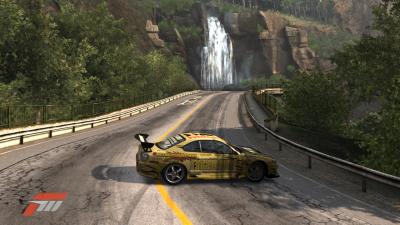
Tunnel Vision: You're doing it wrong.

But sometimes, Tunnel Vision can go beyond the edges of a race track or its racing line. It can narrow or widen at will, based on what’s ahead at the time and how a driver responds to it. For example: when trying to line up a pass on an opponent, the edges of a driver’s Tunnel Vision can alter based on what that rival is doing. If they choose to stick to the racing line heading into a corner, then suddenly the Tunnel Vision can widen beyond the racing line as a passing opportunity up the inside arises. Instead of being single file on the racing line, the track becomes wider as the cars go side-by-side, maybe to the edges of the track, maybe to some point in-between that’s suitable enough to make the move and nothing more. Of course, that doesn’t always mean the pass is going to be successful but alas, I digress.

How does this relate to racing games and in particular, Forza 3? Well just as these games simulate the various mentalities that can arise effectively, they also simulate Tunnel Vision. As I suggested in my previous post, if my attention is not fully dedicated to the racing line, the clock, or both, then I’m not at the peak of my potential ability as a driver and I’m allowing distractions, such as the paraphernalia that adorns the background and sidelines of the circuit, to set in and affect my chances in achieving my goal. It is a small aspect of racing but one that is absolutely crucial to my -- and presumably everyone else’s -- success. Get it wrong and the desired result -- winning, pole position, etc. -- is a lot more complicated to achieve, but get it right and the result is, well, perfection.

Friday, May 21, 2010

Friday Night Forza: Driver Mentalities

In terms of simulation the physics of the driving models in racing games like Forza Motorsport or Race Pro are usually what receives the attention critically, and for good reason too; If the physics and dynamics of racing a car quickly around a race track do not feel right -- regardless of whether it’s a controller or steering wheel being used -- then the illusion is broken and the experience becomes less enjoyable. Or worse, dull. Get it right, however, and it can be an exhilarating, fulfilling experience that is probably as close to real life racing as one can get in a virtual sense. But just because handling is the main focus that doesn’t mean that there aren’t other aspects of racing that are being simulated simultaneously.

Driving a race car consistently, precisely and most importantly, quickly, is an incredibly complex and involving task. Not only do drivers in real life need to manage the physical side -- acceleration, braking, gear changing and, of course, steering* -- they also have to manage racing mentally, and it’s here where racing sims do a pretty remarkable job of capturing the mental processes a driver has to go through not just throughout a race but in preparation for one as well.

Most real life race weekends follow a schedule that allows for drivers to learn the track; test various car setups that suit not only the track but its conditions as well (sunny, overcast, rainy, etc.); secure their position on the starting grid; and then, eventually, the race. The thought process in the approach to each session -- practice, qualifying or the race -- differs based on the performance of the car, the goals the driver or team may have, and the experience with how the track may or may not change over the course of the weekend. In practice for example, the mindset is relatively relaxed and it’s here where experimentation with setup, different racing lines and when to be on the track versus being in the pits can be used to potentially improve the prospects for the overall weekend. In qualifying, the mindset shifts to one lap dashes (usually involving three laps: the out/warm up lap, the actual lap where a decent time is hopefully set, and the in lap on the way back to the pits) where concentration, focus and absolute precision is necessary to set and achieve the best lap time. Arguably, it’s here where the track really does become like a tunnel, the driver’s vision not focused on anything else except what’s in front at the time. I’ll explain this “tunnel vision” phenomenon in a little more detail in my next post. Lastly we have the actual race, where the mindset once again shifts and all eyes point towards a victory. Concentration isn’t necessarily focused on precision -- though it helps -- with the location of competitor vehicles being important, and avoiding any collisions is crucial.

Something that both surprised and impressed me while playing Forza Motorsport 3 is just how amazingly realistic it is in recreating the various mindsets a driver has. Of course, to speed up the process and not alienate the more impatient audience of gamers out there, the way race events are presented in these games is significantly different to the way a normal race weekend pans out, but this is mostly irrelevant. Instead of practice sessions or qualifying, racing games have testing (for the tuners out there) and time trial modes, not to mention quick races or free runs. It’s in these modes that the varying mental approaches appear, and in reality it doesn’t matter what a mode or session is called because the end result is going to be the same thing.

I’m a fairly passionate person about time trial modes, as I enjoy the challenge in being as precise and perfect as I possibly can. As far as Forza 3 is concerned, I have a goal in mind to be in the top 200 people around the world for each specific time trial event, and, if possible, the various hot lap leaderboards as well. It’s a big ask but based on my experience with Forza 2, it’s entirely possible and I’ve already got a few decent times down. When I’m on the track pushing to be as perfect as I can be, my mind is focused entirely on precision, and getting the best out of the track and car I’m in. My focus is literally that of the tunnel vision I’ve already alluded to, and the side and background detail of a track -- including the walls if it’s a street circuit -- is ignored without even realising it. It’s just me, the racing line, and the clock, and if anything else enters into my concentration span then I’m not at the peak of my potential ability. This is a big contrast to how I approach a race, where, as in all racing games, all I care about is winning -- both for the progression throughout a game and because that is the ultimate position. Failure to win means restarting or retrying a race until that victory is secured, and anything else is just trivial distraction until that is achieved. This changes again when it comes to approaching, say, an online race against real people (as opposed to AI); the desire to win remains as strong as ever but the variables are different, so the approach needs to be. Racing against the AI cars is serviceable but mostly predictable: assuming how they will react as I make a pass or block my line into a corner results in relatively easy outcomes with very few surprises. Racing real people, on the other hand, is unpredictable: the lines that they take, how deep (or early) they will brake into a corner or whether they will try to ram you as you make a pass are just some of the unknown factors against real people. This unpredictability can make online racing really exciting, but also has more potential for collisions, unfair competitors and less of a chance to actually win. The differences in the various approaches I take depending on what I do in the game is remarkable, and extremely similar to how a real race driver would adapt to the conditions they may have to face.

Exit Strategy

At any given time on the track, a driver’s thought process can be focused on a multitude of things depending on the circumstances they find themselves in. Ranging from how they took the previous corner to whether they are close enough to an opponent’s car to make a pass, decisions are constantly being made based on what is being presented at the time. It’s no different in a racing simulation game.

I may not realise it while playing, but I too am making decision after decision as I make my way around a track, and as you’d expect, the choices I make will either help or hinder the outcome of my race. For example, exiting the final corner of America’s famous race track Laguna Seca can present many different situations to deal with. As I exit, I could be thinking about my throttle application because I may have gone wide (off the racing line); started to accelerate too early (thus inducing wheel spin); or because I’m trying to get the best exit possible. This latter point can be for two reasons: to end a fast lap as precisely and as quickly as I possibly can, in order to obtain a decent lap time, or, to get the best run down the short straight as I can in order to hopefully make a pass heading into turn one. This second situation gives yet more possibilities: am I close enough to my opponent’s car to slipstream him? What about close enough to brake later than him into the first corner? Or do I need to patiently bide my time, because I’m not close enough, and wait for another opportunity to pass? While thinking about these potential scenarios and what to do with them, I also have to be mindful of what my opponents are doing, too. They could be aggressive and therefore hard to pass; they might not see me alongside them heading towards the corner and so when they turn into it like normal, they cause a collision; or they could be slow -- either because they had a poor exit from the corner or because there’s something wrong with their car -- meaning I have to be careful not to ram into the back of them because I’m going faster.

These are just some of the potential situations that can occur leaving the final corner of Laguna Seca. There are plenty more, and that increases exponentially once you consider the rest of the corners -- including the famous Corkscrew -- that make up the Californian track. And that was just one example! The mental prowess required to not only race quickly but competitively and precisely is amazing, and now that I have noticed it I am impressed by just how well racing simulation games manage to replicate that complexity yet still maintain the fun factor videogames are usually known for. The intriguing thing though is that despite all of this, motorsport is mostly a reactionary sport which relies on reflex and quick thinking as opposed to careful consideration and planning. You can strategise for a race as much as you want but at the end of the day, once you’re out on the track and the light has gone green, it’s just you, your opponents, and the path to victory -- it’s up to you to deal with whatever comes your way, and it will always be the drivers who are best at doing this that will come out on top.

*A lot of people assume motorsport is just a hand-based sport but it is as much a foot skill as it is a hand skill.

Friday, May 14, 2010

Friday Night Forza: Overview

I love Forza Motorsport 3. The latest in a franchise I’ve played since inception, the game is the culmination of years of dedicated and hard work by developers Turn 10 to create not just a product capable of going up against (and, in some people’s eyes, beating) well-established rival Gran Turismo, but also one that explains, enhances and allows players to experience car and Motorsport culture and the passion that is born from it. From a pure videogame point of view, it wasn’t hyperbole when the word definitive was thrown around by both Turn 10 and Microsoft in the lead up to its release: Forza 3 doesn’t just iterate on its previous versions, it takes everything they learned from the previous two games -- but particularly Forza 2 -- and delivers the package that, in hindsight, some might say the original game on the Xbox should have been. Whether it’s racing on the track, tuning or painting, every aspect of Forza 3 isn’t just a polished piece of work that could be in their own separate games; they also exist as a significant factor in creating the Forza Motorsport experience. If LittleBigPlanet has "Play, Create and Share", then Forza’s racing, tuning and painting combine to form a community whose strength doesn’t just rival that of Sony’s effervescent and utterly charming franchise, it eclipses it. Why? Because a love of cars can be shared by all sorts of people, and car culture is global.

As you can see, I love Forza Motorsport 3 but more than that, I love the franchise and the genre that it exists in. As a Motorsport enthusiast in the real world, Forza allows me to drive real cars on race tracks in a realistic manner, enhancing an enjoyment of a sport I already love as well as fostering my passion for it by providing an understanding of what it’s like to not just drive cars, but to do it at speed and as precisely as possible. At the end of the day it may just be a simulation, and I may use the controller the majority of the time, but regardless of its input systems and approach to racing games and racing in real life, Forza clues me into a lot more than I think some people -- who aren’t necessarily in my position -- may realise. Basically, the depth Forza has as a game and franchise -- and let me be clear right now, Gran Turismo shares this complexity -- alone is astounding, but when you consider its ability to provide insight into racing in real life as well, well that is nothing short of exceptional. That’s why it is my equivalent to the annual iterations sport games receive; it’s why Forza 3 is my RPG where statistics are pored over, main quests and individual quests are undertaken, leveling up and character progression occurs and ultimately a narrative is told; and it’s my first-person shooter, where I don’t just get to test out my skills, I also must practice my precision, my aim, my reactions, and decide the best time to fire out of every corner. Winning a race is the equivalent to a team winning an intense, competitive multiplayer match, whilst achieving a perfect lap time is my very own version of a headshot.

So, with that in mind I welcome you to my weekly (yes, you read that right: weekly) column about Forza 3, in which I’ll cover everything from personal opinions on the game to analysis of the game’s tracks, modes, and just the game in general. I cannot emphasise enough just how many different areas I could explore with this game and so, as a demonstration of my love and respect for it, writing about all of these things will allow me to describe to you not just why I feel the game is amazing, but the intricacies of both it and the culture it resides in. Videogame elements or real life racing techniques -- it can all be covered in this series. I might even be able to record some footage of the game too in order to demonstrate the points I make or to show you what I might be referring to, so while I admit this series will be an experimentation of sorts, it will also be a varied bunch of subjects that I hope -- even if you have no interest in cars, racing games or Motorsport -- will interest you. And if, by chance, I run out of things to say about Forza Motorsport 3, then I can use this column to discuss the racing game genre -- or franchises within it -- instead, so there should be no reason for this regular addition to the blog to run out of content.

It begins next Friday with a look at driving mentality whilst on the racetrack, a subject that doesn’t just apply to racing in the game but also racing in reality. Hope to see you then.